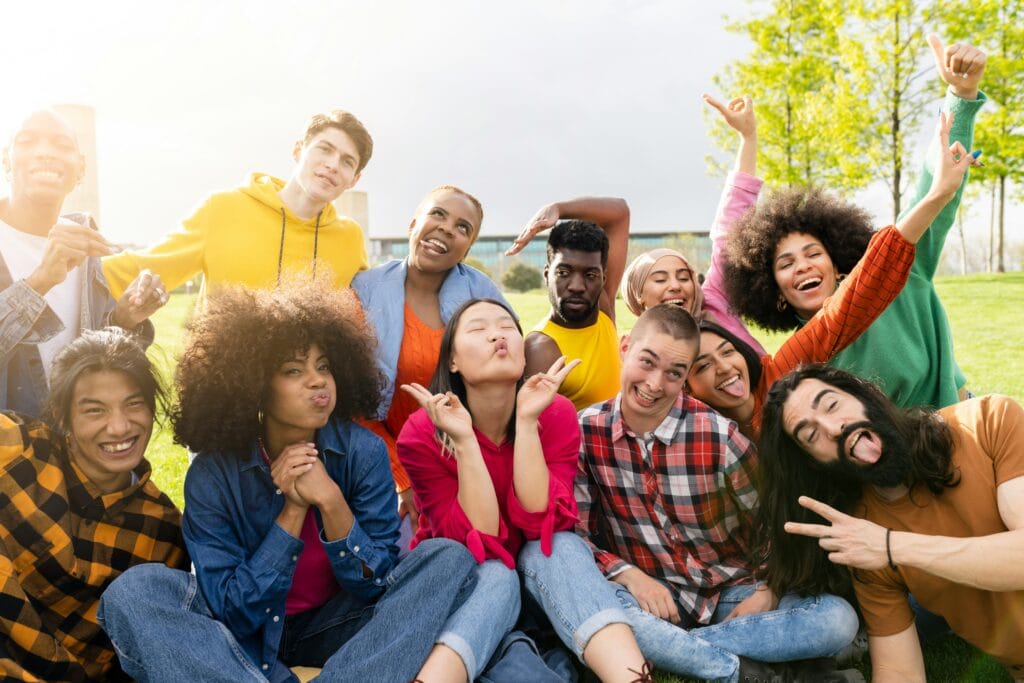
There are many places where people can find belonging. There are sports teams, faith communities, schools, and neighborhoods. However, few do it as reliably, as quickly, or as deeply as summer camp. In an era when connection is technically easier than ever, that might seem puzzling. Aren’t we more plugged in than ever before?
The truth is, we’re more connected but less belonging. And that distinction matters enormously, especially for young people.
The Belonging Paradox
Smartphones and social media promised us community at scale. What they often deliver instead is comparison, performance, and a low-grade loneliness that hums quietly in the background of daily life. Instant gratification and algorithmic feeds optimize for engagement, not intimacy. The result is a generation that is technically more “connected” than any before it, and yet, by many measures, more isolated.
This is precisely why places like camp are more valuable than ever. Camp’s structure automatically creates belonging.
Belonging Is a Basic Human Need
This isn’t a soft claim. It’s science.
Abraham Maslow placed belonging squarely in the middle of his famous hierarchy of needs, just above safety, and before esteem or self-actualization. As humans, we are wired to seek it. When it’s missing, everything else suffers: focus, confidence, resilience, even physical health.
More recently, psychologists Edward Deci and Richard Ryan developed Self-Determination Theory (SDT), which identifies three core human motivators: autonomy (the sense that your choices matter), competence (the sense that you are capable), and relatedness (the sense that you are genuinely connected to others). When all three are met, people flourish.
Well-run camps hit all three simultaneously. Campers make real choices about how to spend their time. They tackle challenges that stretch their abilities inside a community that sees and values them. For camp directors, SDT offers a powerful vocabulary for articulating your program’s value to parents, boards, and funders.
What Camps Do That Schools Often Can’t
Camp’s structure belonging into their programs. Sometimes intentionally, sometimes through decades of tradition that encodes wisdom we didn’t even know we were passing on.
A few of the most powerful belonging accelerators at work are:
Mixed-age grouping. When older and younger campers share space and responsibility, they build relationships that mirror family dynamics through mentorship, care, and a sense of legacy.
Shared physical challenge. There’s something about doing hard things together, like a long hike, a cold lake, or a ropes course, that bonds people in ways that conversation alone rarely can.
Removal of status hierarchies. At camp, the clothes you wear, the follower count you have, and the neighborhood you come from mostly disappear. Everyone’s sweaty. Everyone’s a little lost on the first day. That leveling is profoundly freeing for kids who have spent the school year navigating complex social ladders.
Rituals and traditions. Camp songs, inside jokes, ceremonies, and flag-raising routines aren’t just fun; they are identity-forming. Shared rituals signal: you are part of something larger than yourself. They create an “us,” and that “us” is one of the fastest routes to belonging there is.
Continuity of relationship. When a camper returns to find the same counselor, or when that counselor remembers their name and their story, it communicates something powerful: you matter, and you were not forgotten.
Why Adolescence Makes Camp Irreplaceable
Developmental psychologist Erik Erikson identified adolescence as the critical stage of identity vs. role confusion. It’s a period when young people are actively asking: Who am I? Where do I fit in? What do I stand for?
Camp arrives at exactly the right moment. It offers a “try-on” environment, a place where identities can be explored, tested, and refined with low stakes and high psychological safety. Away from the social pressures of school, a shy kid becomes a cabin leader. A kid who “isn’t athletic” discovers they love archery. A homesick nine-year-old becomes a confident ten-year-old who can’t wait to come back.
These are not small moments. They are formative ones. For educators and directors thinking about the deeper purpose of their programs, Erikson’s framework is a reminder that you are not just running activities. You are providing the conditions in which identity takes shape.
What the Research Says
The American Camp Association (ACA) has tracked camp outcomes longitudinally, and the findings are striking. Campers show meaningful gains in self-confidence, quality of friendships, peer relationships, and sense of identity and values — with effects that persist well beyond the summer.
For directors making the case for funding, enrollment, or program investment, this research is worth knowing well. Camp’s return on investment isn’t measured only in skills learned or merit badges earned. It’s measured in the psychological development of young people who leave the summer knowing, more clearly, who they are and where they belong.
The Counselor as Belonging Architect
None of this happens without the people in the middle of it: the counselors.
A good counselor is, in the truest sense, a belonging architect. They learn every camper’s name and use it often, because being named is being seen. Counselors notice the kid who hasn’t clicked yet and find a way to fold them in. They build cabin inside jokes and traditions that make their small group feel like a tribe. They model vulnerability, repair conflict, and hold the emotional tone of the space.
This is not incidental to the counselor’s job. It is the job. That means staff training shouldn’t just cover safety protocols and activity logistics. It should actively develop belonging skills. Who’s on the outside? How do you build a cabin culture? How do you repair a rupture in a group? These are teachable, learnable, and coachable skills, and investing in them pays dividends in every camper’s experience.
What’s Worth Defending
Camps today face real pressure: to add screens, to shorten sessions, to over-program every hour in the name of demonstrable “outcomes.” Some of these pressures come from well-meaning parents or from market forces. Some come from a culture that has forgotten, or never quite learned, how belonging actually works.
The research and the psychology are clear: belonging takes time, embodied experience, shared challenge, and the removal, not the addition, of the digital noise that fragments attention and manufactures comparison.
The conditions that build belonging are worth naming and protecting, and in a world that is making genuine connection harder and rarer, the programs that get this right are not just offering a nice summer. They are offering something genuinely irreplaceable.
The belonging that forms at camp doesn’t stay at camp. It becomes part of who a young person believes they are. That is a gift that lasts a lifetime.